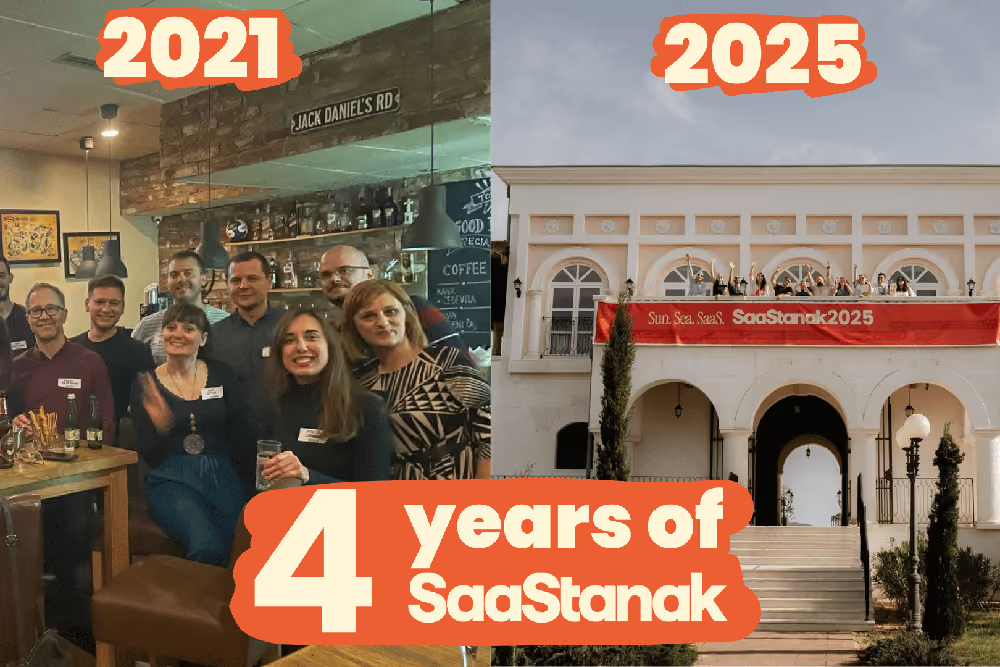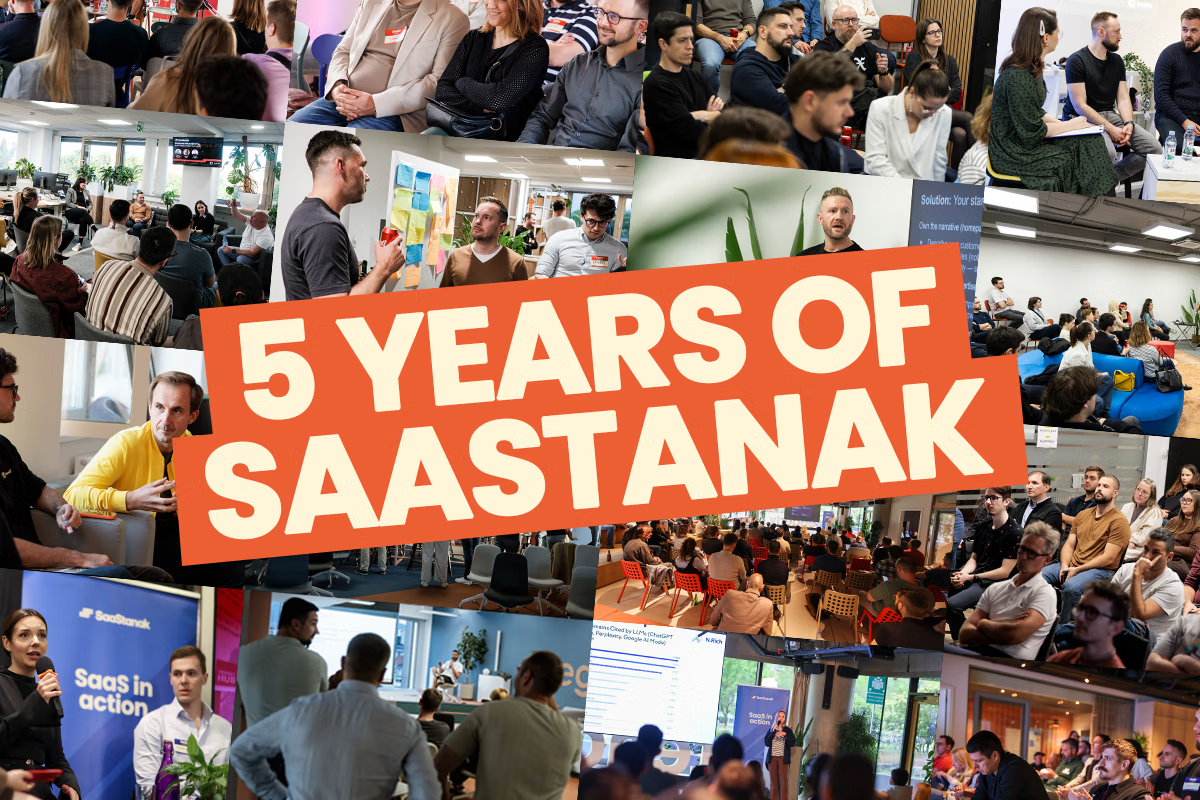

I started SaaStanak 5 years ago today, and we've seen the industry go from 2021 highs to the current state of malaise. SaaS has gone from sexy to downright toxic branding, and "B2B software" is in a weird place as a whole.
Why I started an AI native business
For over a year now, people have been asking if we're going to switch the name to AI-tanak, which is funny, especially since the literal translation from Serbo-Croatian would be "AI thin".
That kinda describes most of the app layer of AI these days - a thin layer of actual "app"; most of the heavy work is on the model.
So I wanted to dive deeper into the "AI native" category, and I find the best way to learn is by doing it yourself. Being in the event industry, I recently co-founded Konfi, an AI agent for events that some of you got to try at this year's SaaStanak, Sculpt, Lenny's Summit and other events.
What I found is that although we ship code extremely fast, the real complexity sits in the sheer volume of product decisions. The more development speeds up, the more decisions we need to make & faster. And if you want a good product, you're handling those decisions yourself, or with your fellow humans.
And since we're celebrating 5 years of getting our SaaS community together, I wrote down 5 honest thoughts on the state of the industry in 2026:
1) Customers & investors have increasingly high expectations
Customers are bombarded with AI native companies advertising, which is a result of AI funding being a series of concentrated "kingmaker" bets. This impacts their expectations, so you can't afford to launch with an incomplete product.
Higgsfield for AI video, Legora/Harvey for legal AI, Lovable for vibe coding, the category-defining companies win over a disproportionate amount of funding and invest in distribution. The winning founders right now are those who know how to play the VC game, but the categories are so young that it's unclear how durable these businesses are. Lovable has shared everything about their business but churn.
I think you can still win by delivering a great product experience. AI products are mostly prosumer-type; I'd argue B2B is still wide open and can be won by products that execute flawlessly.
2) Your agent, my agent problem
It's been more than a year of AI chat overlays in SaaS apps and the verdict is in - customers that use AI want to use "their agent". For the customers that prefer headless, you're better off working on your MCP than focusing on your harness in most cases. And for the customers who stay in your UI, AI is often making it worse.
I'm a long-time customer of Veed.io, and I was surprised by their push to generative video above the actual recording/editing functionality. Being met with the prompt bar and finding my way to edit/record is getting harder with every UI update they do, and frankly, it's annoying. AI video generation and editing existing footage are two separate modes of working, and a good product will recognize when you're doing one or the other (or find a good middle lane).
I'm not sure how you do a great interface in 2026, but I feel like the current approach is not it. We'll talk about this a lot at SaaStanak 2027.
3) Moats hold when you're siding with the customer.
Moats are the talk of the town and a great example of a durable moat is what Slack Connect provides to Slack. For some, moats are fading away - two examples:
Figma's multiplayer design is reliant on the actual process of designing. Their network effect is disrupted by AI changing the actual mode of work - prototyping changed so the design steps changed with it.
Switching costs are eroding - Autodesk's monopoly on the ecosystem built on file formats is changing with AI being able to correct dumb geometry.
Both of these examples are moats of the past, as one is the inability to adapt to new reality and the other is a customer lock-in instead of a benefit. The new app layer will have to figure out how to build durable moats in the customer workflows, AI and human collaboration, and product networks. I think it's exciting - you can literally disrupt companies listed on NASDAQ from your bedroom.
4) Pricing on outcomes is pricing on outputs
If your product drives repeatable process resolution an agent can control end-to-end, you can price on outcomes, right? Well, the reason why someone buys your software is usually tied to a long-term goal of the business. Producing outputs, such as ticket resolution, is not an "outcome"; a high NPS score is.
Fin can't price at the level of your NPS as it can't control it end-to-end. It can, however, control the number of AI outputs.
So what you mean by "outcomes" is actually actions & workflows. And yes - you should price on completion instead of selling an in-game currency (AI tokens).
Customers still prefer predictability, and if you can abstract away the AI cost, you're de-risking the customer's bet on you.
5) The app layer is not dead, and you don't need to become a service business
The pundits' answer to the death of software is a switch to services. Developing AI workflows. AI-powered real-life businesses, etc.
Services are not the "opportunity". A real product that leverages AI and gives customers tools to execute is. Promising outcomes is fine, but customers should be in a better spot and not dependent on FDEs or service businesses to maintain or use it.
That's a custom software development business, and no matter how great the models get, the app layer wins on reliability, support, and predictable cost.
This doesn't mean a lot of apps aren't dead. It means that those that remain, get funded or grow faster are better at delivering reliable outcomes.
Clear your context window
And lastly - it's never been easier to keep yourself isolated in your terminal prompting AI for opinions. If you're looking for a way out of the rut, clean your context window and come to SaaStanak. Humans are still good at solving problems! You'd be surprised how many interesting people are mulling over the same stuff as you do.
What SaaStanak 2027 will tackle next year is directly tied to clarity on product strategy, strengthening moats, and driving real value for the app layer companies & their customers - be it "AI native" or incumbents.
Thank you for the wonderful 5 years – we're not dead, and neither are you. As long as that's true, we'll be sipping wine at the coast for many years to come. Love you all, SaaStanak 2027 is hapenning again next year from May 24-26th – buy the blind bird tickets, it won't go cheaper than this :)